

The Death of Sales Calls
The Birth Of Case Calls ™


Introduction
Sales calls are costing you sales.
Prospects dislike them, and so do you.
Who wakes up in the morning thinking, 'Gee, I can't wait to hop on a sales call today!'

Sales calls are about as popular as a root canal.
In a world where content marketing, AI, and other advanced digital selling tools are taking over, sticking to old-school sales calls is like trying to sell a flip phone in an iPhone world.
It's time to adapt or risk becoming a dinosaur.
The solution?
The Case Call Method.
This innovative approach is the superhero of sales—here to save the day and replace those dreaded sales calls. In this article, I'll be your trusty Batman, guiding you through the ins and outs of the Case Call Method and showing you how it can revolutionize your sales game.
So buckle up, buttercup, because we're about to embark on a wild ride to sales success!
Thesis
The Case Call Method transforms sales calls from cringe-worthy pitches into targeted, informed discussions with pre-sold leads. It's turning a blind date into a love story—suddenly, the prospect is already head over heels for you!
With my 20 years of experience as a third-generation sales professional and trainer, I'm the Yoda of sales—here to guide you on the path to sales enlightenment. Say goodbye to the grind of outdated sales calls and hello to streamlined, high-impact strategies that work.
This method doesn't just align with modern consumer behavior—it revolutionizes it. It's giving your sales process a makeover, complete with a new wardrobe, a fresh haircut, and a killer smile.
Optimize your efforts, cut costs, skyrocket customer satisfaction, and boost your reputation. Imagine increasing sales with less effort and higher price points—it's winning the lottery without even buying a ticket!
Ready to ditch the old school for something that works?
Let’s dive in.
The Origin of the Case Call Methodology:

The Case Call Methodology is the love child of my frustration with traditional sales tactics, conceived after years of banging my head against the wall (figuratively, of course).
My journey began at 18, selling advertising to local businesses.
Despite having a great product, I struggled with a fundamental issue: why do great products still need direct selling?
This question nagged at me for almost two decades, through various roles and businesses, including when I started training coaches and consultants in client acquisition in 2016.
I realized that the problem was more complex than a Rubik's Cube on steroids.
Most businesses and individuals struggle to establish a reputation. Even when they had a good product or service, they faced challenges in generating strong word-of-mouth. The root of the problem often lies in poor vetting processes, leading to mismatched clients and lackluster results. This inconsistency harmed reputations and stifled growth.
Traditional sales calls increasingly clash with modern trends, ill-suited to many temperaments. The pressure to be good at sales kills many entrepreneurial dreams.
I wanted a method that solved these problems.
I crafted the Case Call Method through years of working with thousands of diverse personalities and skill sets and drawing from my extensive background as a third-generation sales trainer.
This approach addresses the critical gaps in traditional sales and closing methods—providing a framework that emphasizes rigorous vetting, transparent content, and a reputation for exclusivity.
The Case Call Method ensures businesses engage only with well-suited clients, leading to stellar results and enhanced reputations.
In essence, the Case Call Method transforms the sales process, eliminating the need for hard selling and allowing businesses to operate with greater efficiency and effectiveness. It’s designed to create a high-status perception, attract pre-sold clients, and ultimately, close deals with ease and confidence.
It took me a good eight years of honing different elements of the Case Call Method to get it right before releasing it to the public. I'm sure I will continue to evolve it, but as I've done a soft release of it over the years, I've received feedback from all over the world, telling me how groundbreaking it is and how people have never seen anything like it before. They can't wait for it to come out.
Well, here it is in all its glory.
While it's impossible to give an example for every business, the Case Call Method can work for most high-ticket businesses and all client-based businesses.
For detailed implementation, we are now beginning to work with clients in our training programs to integrate this methodology into their entire business for individuals and teams alike.
This is the complete overview with nothing held back or hidden.
Section 1: The Problem with Sales Calls

Inefficiency
Sales calls are outdated in today's digital landscape. Customers avoid them at all costs, viewing them as drudgery instead of opportunities
This aversion is well-documented: potential buyers often avoid direct sales interactions due to discomfort.
They dodge unknown numbers, procrastinate signing up, let calls go to voicemail, and feign interest only to disengage.
Sales calls create barriers rather than bridges.
Customers prefer experiences without direct sales.
Humans will do more to avoid pain than they will do to gain pleasure.
Modern buyers seek seamless, pain-free purchasing processes. Businesses clinging to sales calls will soon be edged out by those offering better customer experiences.

Acquisition vs. Selling: Acquisition is about attracting and engaging customers, creating a magnetic pull. Direct selling relies on convincing, which is inherently anti-persuasive.
Convincing someone implies that they are being swayed to accept something they initially resisted, which creates a low-status dynamic where the salesperson is needy and the customer holds power. This conflict in frame control cannot be avoided. However, it is often attempted with brash high-pressure tactics.
In today’s sales environment, this dynamic is counterproductive.
Effective persuasion today focuses on positioning, authority, and value delivery at scale.
Content marketing shines here, letting businesses broadcast their message far and wide without resorting to desperate, low-status sales tactics. Think of Case Call content as a lighthouse, attracting pre-sold prospects who are informed and eager to buy. No more awkward convincing—just smooth, straightforward selling.
Missed Opportunities: The inefficiency of sales calls is multifaceted, involving wasted time on uninterested leads and resources spent managing sales teams. It's also about missed opportunities—customers who bypass a business because they perceive the sales process as too painful.
Every unanswered call, every avoided interaction is a potential sale lost, a customer diverted to a competitor with a more appealing, low-friction buying experience.Outdated Assumptions: Organizations relying on sales calls hold outdated beliefs. They think direct sales tactics are essential for closing deals, but today's consumers are informed, empowered, and impatient with direct sales. They seek value, authenticity, and ease. Successful businesses recognize and adapt to this shift in consumer behavior.
The bottom line: Sales calls are dinosaurs. The Case Call Method eliminates inefficiencies, saves time and resources, and aligns with modern consumer behavior. This leads to smoother, more successful sales and a happier customer base.
Time to retire the sales call fossil and embrace the future!
A Mini History Lesson: From Necessary Evil to Obsolete Practice

In the pre-internet era, sales calls were a necessary evil, like dial-up internet or fax machines. Businesses relied on them for lack of better options, using them to inform, address concerns, and close deals. Personal connections were key.
Fast forward to the late 20th century: mass media such as TV and radio supplemented sales calls, but their interactive element kept them relevant, like VHS tapes in a Netflix world.
Enter the Internet: websites, email, and digital marketing revolutionized interactions. Businesses could engage potential customers more efficiently, leaving sales calls looking like your grandpa's Rolodex.
Today, social media, content marketing, and advanced analytics reign supreme. They enable precise targeting, and real-time engagement, and build trust without the awkward intrusion of sales calls.
Simply put, sales calls are outdated relics. Modern buyers prefer researching and engaging with content at their own pace, free from interruptions and pressures.
The digital age offers superior alternatives that align perfectly with contemporary consumer behavior, making sales calls as appealing as a public restroom.
Why Direct Selling is Anti-Persuasive

Direct selling is like trying to sell ice to an Eskimo—it's not just ineffective, it's downright embarrassing. By playing the role of a desperate salesperson, you're essentially saying, 'Please, take pity on me and buy my stuff!' Not exactly a power move, is it?
Instead, flip the script and become the valuable asset that prospects are clamoring to get their hands on. You'll be the last slice of pizza at a party—everyone wants a piece of you.
And let's be real, those 'Discovery Calls' and 'Strategy Sessions'? They're just sales calls in disguise. It's like trying to pass off a hamburger as a gourmet steak—sure, it might look kinda similar, but we all know the truth.
Starting with deception is building a house on quicksand—it's just not a solid foundation for a trusting relationship.
Convincing is the same as trying to sell a car to a fish—it's a waste of time and energy. Sub-communication is where it's at. It's like wearing a subtle, yet irresistible perfume—you don't need to shout about it, but everyone around you can't help but notice.
Take a cue from the ladies, who have a sixth sense for sniffing out low-value men. High-status men don't need to sell themselves—their charm, wit, and good looks (or at least their confidence) do all the talking. Entrepreneurs take note: if you have to direct-sell yourself, you're doing it wrong.
Let your success speak for itself in scalable content—it's the ultimate mic drop.
Expert-Based Sales and Why Convincing is Counterproductive
Convincing is especially counterproductive in expert-based sales, like coaching and consulting. Here’s why:
Convincing in expert-based sales? Oh, honey, that's trying to teach a fish to ride a bicycle—it’s just not a natural fit. True experts have clients flocking to them like groupies at a rock concert. If you have to convince someone, it's admitting,
"Hey, I might not be the expert I claim to be!”
But here's the thing, natural leaders don't need to convince anyone. They're the cool kids at school—everyone wants to be part of their crew. Trying to convince someone to follow you is forcing a square peg into a round hole—it's just not going to happen.
Now, you might be thinking, "If sales are anti-persuasive, why do they work?" Well, people buy despite the convincing tactics, not because of them. It’s like buying a product because it's endorsed by a celebrity—you’re not convinced by their persuasive skills, you’re just drawn to their status and influence.
Section 2: Introducing the Case Call Methodology

What is the Case Call Methodology?
This bad boy is the secret sauce for high-ticket, client-based sales. It's the personal matchmaker for your business—connecting you with only the most serious, ready-to-buy prospects. Forget about throwing spaghetti at the wall and hoping something sticks.
With the Case Call Method, you're only working with prospects who are already primed and ready to say 'I do' to your offer. It's like having a crystal ball that shows you exactly what your prospects need and how to address it—no more awkward first dates or wasted time on tire kickers.
This method is like a well-oiled machine, meticulously vetting prospects through a structured pre-call and call strategy.
The result? Higher conversion rates, a smoother sales process, and more time to sit back, relax, and watch the sales roll in.
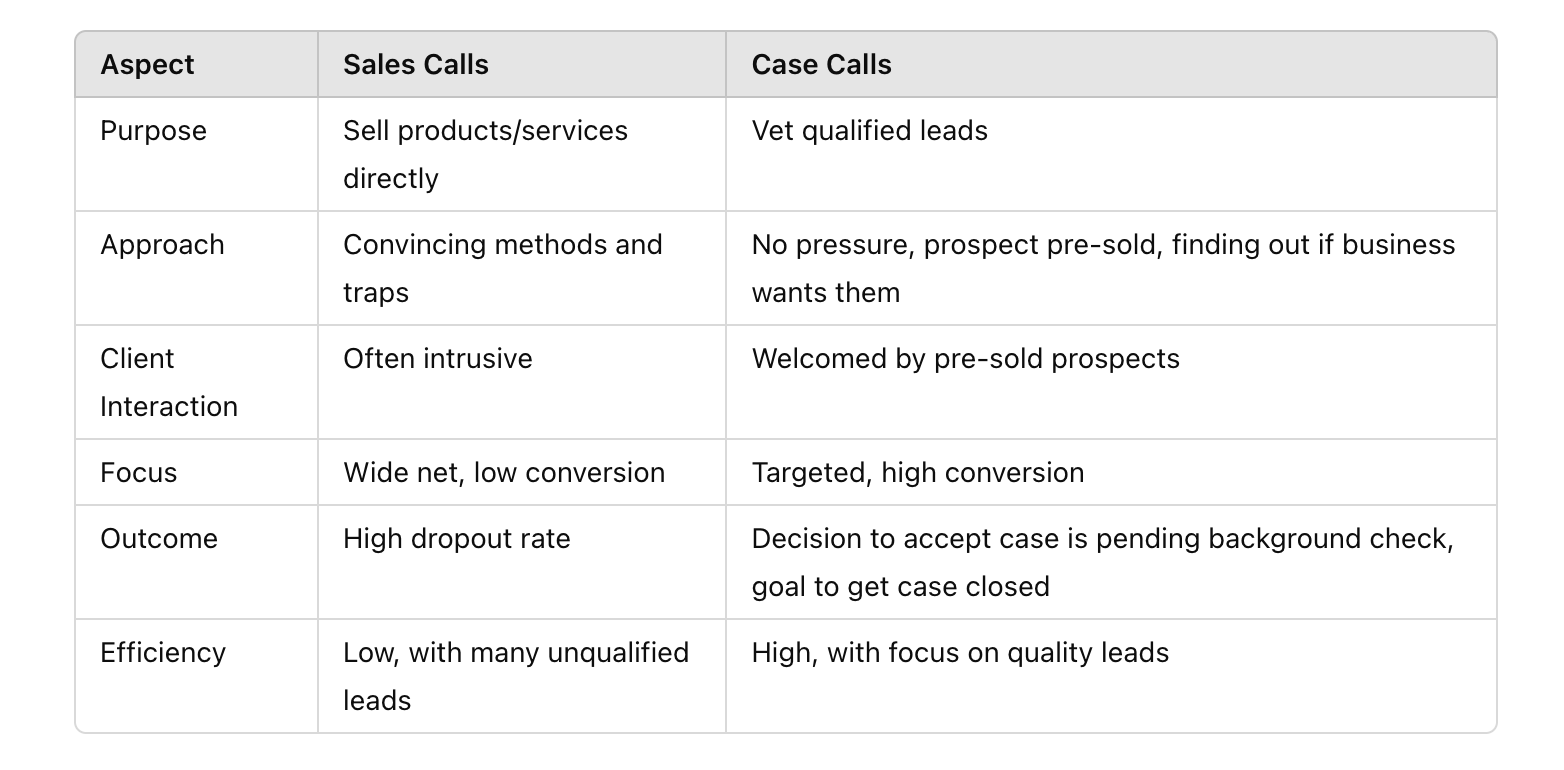
The Case Call Method: A Radical Shift in Sales
Our approach is like a breath of fresh air in a world of shady sales tactics.
We're all about radical transparency and a fierce commitment to our reputation.
This is why we vet more thoroughly than a TSA agent at a crowded airport. We want to be sure every client is a perfect match for our services, like a tailor-made suit that fits like a glove.
Phase One: Traffic Generating Content
The journey begins with targeted content designed to attract your ideal audience. Whether through organic blogs, social media posts, or paid ads, the goal is to spark interest and draw potential customers into the initial phase of our funnel.
Phase Two: In-Depth Teaching-Based Content
Engaged prospects then receive comprehensive, educational content. This phase addresses all their questions and concerns, showcasing our commitment to results over sales.
We believe happy customers are the best form of advertising, and our reputation is our greatest asset.
We transparently share all details, including pricing, helping prospects make informed decisions, and ensuring they are committed to working with us by the time they reach the Case Call.
Phase Three: Decision to Engage
At this stage, well-informed prospects decide if they want to proceed. Our commitment to excellence means we don't stop there.
We strive for a 100% success rate with our clients, knowing success stories are the best advertising.
Phase Four: Application and Case Call
We ensure every prospect understands exactly what to expect in the application process. This transparency is crucial to maintaining trust and ensuring a smooth transition to the Case Call.
Here’s how we achieve this:
Clear Communication: We communicate all details to the prospect from the beginning. They know that, if we decide to proceed, they will need to secure funding and make payment via wire transfer, including a non-refundable $2500 deposit during the Case Call.
Detailed Information: Prospects receive comprehensive information about every step of the process. We provide detailed documentation and thorough explanations, leaving no room for misunderstandings.
By the application stage, they know exactly what they are committing to and what is expected of them.No Surprises on the Case Call: When prospects enter the Case Call, there are zero surprises. They’re already well-informed about the process, requirements, and financial commitments.
Both parties come to the table with a clear understanding: they’ve decided to work with us, and now the ball is in our court to determine if we are a good fit for them.Mutual Decision-Making: The Case Call is about mutual decision-making, not convincing the prospect. Since they know everything about our business, methods, and expectations, the Case Call focuses on assessing their fit with our criteria. We evaluate their needs, their commitment, and their ability to follow through.
If we decide to proceed, the $2500 deposit will be collected during the call and applied to the final balance pending a thorough background check.
We build a trustworthy foundation by ensuring complete transparency throughout the application process.
Prospects are well-prepared and confident, knowing they have all the information they need to make an informed decision. This approach eliminates uncertainty and sets the stage for a successful relationship.
Phase Five: Background Check and Securing Funding
While the background check is underway, the prospect secures their funding. Once approved, they wire the balance, activating their case.
Case Closed
Our ultimate goal is to solve the client's problem, turning their case into a success story. Once resolved, they become a Case Study for our business and are marked as "Case Closed." These success stories serve as powerful proof of our method's effectiveness, attracting more high-quality prospects.
By focusing on radical transparency, high-value content, and rigorous vetting, the Case Call Method ensures the business and the client are fully committed and aligned.
This leads to exceptional results and long-term success, setting us apart from traditional sales tactics and guaranteeing higher satisfaction for everyone involved.
Section 3: Benefits of Adopting the Case Call Methodology

Section 3: Benefits of Adopting the Case Call Methodology
Adopting the Case Call Methodology offers several key benefits that can transform your sales process and enhance overall business performance. Here are the primary advantages:
1. Increased Conversion Rates
The Case Call Methodology significantly boosts conversion rates. Traditional sales calls often result in low success rates, similar to a car with a flat tire failing to drive. In contrast, the Case Call Method leverages content to attract and pre-qualify prospects effectively.
By pre-qualifying leads through engaging content and the pre-case call process, teams can focus on prospects who are already informed and sold, ensuring more meaningful and productive discussions. This approach leads to higher conversion rates and a smoother sales process, akin to a well-prepared meal leading to a satisfying dinner.
2. Cost Savings
The Case Call Method also offers substantial cost savings. Traditional sales calls require a significant investment in time and resources, including the costs associated with hiring, training, and managing a sales team. The low success rate of cold calls means that a large portion of this investment yields little return.
In contrast, the Case Call Method reduces these costs. Since content pre-qualifies prospects, the sales team can operate more efficiently, focusing on high-quality leads. This reduction in unproductive activities translates into cost savings, allowing businesses to allocate resources more effectively.
The streamlined process of the Case Call Method reduces the burden on sales teams, decreasing burnout and turnover rates, which further contributes to cost efficiency.
4. Enhanced Brand Reputation
Using the Case Call Methodology transforms your brand into the elite club everyone wants to join. Traditional sales calls are like cold-calling your way into a VIP event—cringe-worthy and off-putting. They leave prospects feeling pressured and unimpressed, hurting your brand's image.
The Case Call Method, however, elevates your business to an exclusive status. By providing transparent content upfront, you build trust and rapport before any direct interaction. You're seen not as a pushy salesperson, but as a trusted advisor. Clients feel valued and respected, creating a positive brand perception.
Our selective approach means you choose your clients, ensuring perfect fits and high satisfaction rates. Your brand becomes the talk of the town, known for its exclusivity and high standards.
Happy clients turn into loyal advocates, spreading the word about your top-tier services.
This approach not only enhances your reputation but also drives long-term success and growth. So, step up your game, be the elite brand everyone wants to work with and watch your prestige soar.
5. Finding and Retaining Good Salespeople
One of the significant benefits of the Case Call Methodology is that it alleviates the challenge of finding and retaining good salespeople. Recruiting top-tier sales talent is difficult and time-consuming. Even when you find skilled salespeople, retaining them can be an ongoing challenge due to high turnover rates in the sales industry.
For solo entrepreneurs who aren't naturally adept at sales, relying on traditional sales calls can severely limit their options and success. The pressure to perform sales calls or discovery calls can be daunting and may lead to inconsistent results. With the Case Call Method, even those who struggle with sales can achieve success.
6. More Effective Than Top Salespeople
The Case Call Method focuses on crafting content around the Case Call itself, effectively turning the vetting process into a marketing tool. This approach isn't just about filtering prospects; it's about flaunting how rigorous and selective your business is.
By emphasizing the exclusivity and high standards of your vetting process, you elevate the perceived value of your services.
When prospects see the thoroughness of your screening, they perceive your business as high-value. The vetting process becomes a key part of persuasion, making them more eager to qualify. It's like an exclusive club—everyone wants in, but only the best get through the door.
7. Case Call: The Killer Closer

The Case Call Method is a game-changer in high-ticket sales. Historically, closing a sale required exceptional skills, a specific personality, and a unique temperament. But with the Case Call, anyone can achieve elite-level closing. By the time prospects reach the call, they are already sold.
This method relies on transparency to prime prospects, assuming the sale and initiating the transaction within a leadership framework essential for high-ticket deals. Its structure creates a near 100% closing ratio since only pre-sold prospects make it to the call.
The Case Call isn't just about vetting; it's about setting the stage for a seamless, high-ticket transaction. The process ensures that prospects are fully informed and eager, turning the call into a mere formality. Our coaching program trains entrepreneurs and companies to conduct Case Calls effectively, making them elite closers without the traditional skill set. By focusing on transparency and leadership, the Case Call method transforms the closing process into a predictable, high-success operation.
8. The Anti-Sales Solution for Non-Salespeople
Not everyone is cut out for sales. Traditional sales tactics can feel icky, pushy, and uncomfortable, especially for those who prefer not to sell. The Case Call Method levels the playing field for those who struggle with conventional sales techniques.
This method allows anyone to achieve elite-level sales success without feeling like a stereotypical salesperson. The Case Call Method's structure ensures that by the time prospects reach the call, they are already sold. This eliminates the need for traditional persuasion, making the sales process comfortable and effective for those who dislike sales.
Success in high-ticket sales requires a unique set of skills, personality traits, and temperament. Those lacking these attributes were often left struggling or resorting to passive sales strategies, missing out on the power wielded by top sales professionals. The Case Call Method changes this dynamic. It empowers individuals who shy away from traditional sales to close deals with ease and confidence.
Section Four: The Sales and Marketing Element of the Case Call Method
The Case Call Methodology is more than just a sales and closing technique; it's a comprehensive approach to building and marketing a business around transparency, reputation, quality control, and rigorous vetting.
Structuring your entire business to focus on selective vetting communicates a powerful message: outcomes are more certain due to the careful selection of clients.
This form of sub-communication implies value, confidence, and exclusivity without explicitly stating it.
Closed Cases: A Mark of Success
In the Case Call Method, successful outcomes are referred to as "closed cases." A closed case is synonymous with a happy customer, reflecting a well-vetted and satisfied client. This concept mirrors how prestigious institutions operate.
For example, colleges and universities like Harvard employ rigorous vetting processes to maintain their brand integrity and ensure high-quality outcomes. Harvard's acceptance rate is around 4.6%, highlighting its selectivity and the prestige associated with being accepted.
The selective nature of these institutions enhances their reputation. The harder it is to gain acceptance, the more prestigious the institution is perceived to be. This principle can be applied to businesses using the Case Call Method.
By implementing a rigorous vetting process, you signal to potential clients that your services are in high demand and that you only work with those who are a perfect fit.
This approach not only protects your brand integrity but also increases the perceived value of your services.
Examples of Rigorous Vetting in Practice
Top Universities and Colleges: As mentioned, institutions like Harvard, Stanford, and MIT have extensive vetting processes to maintain their prestige and attract high-quality students. Their rigorous admissions criteria ensure that only the best candidates are accepted, enhancing their reputation and desirability.
Luxury Brands: High-end fashion brands like Hermès and Rolex maintain their exclusivity by controlling the availability of their products and ensuring that their clientele aligns with their brand image. This selectivity enhances the perceived value and desirability of their products.
Professional Services Firms: Elite consulting firms like McKinsey & Company and law firms like Cravath, Swaine & Moore LLP vet their clients carefully to ensure alignment with their values and standards. This selective approach helps maintain its reputation for excellence and reliability.
Exclusive Membership Clubs: Clubs like Soho House and The Battery have rigorous membership processes, ensuring that only individuals who fit their criteria are accepted. This exclusivity enhances the club's allure and ensures a high-quality member experience.
Increased Marketing Effectiveness
When your business is built around quality control, transparency, and vetting, your marketing efforts become more effective. Here’s how:
Enhanced Brand Reputation: Rigorous vetting signals that you only work with high-quality clients, which elevates your brand’s reputation. Prospects perceive your business as more prestigious and trustworthy.
Attracting the Right Clients: By communicating exclusivity and high standards, you attract clients who are serious about achieving results and who value quality. This alignment reduces friction in the sales process and increases the likelihood of successful engagements.
Higher Conversion Rates: Prospects who go through the vetting process are more likely to be committed and well-matched to your services. This alignment leads to higher conversion rates and more successful outcomes.
Building Trust and Authority: A selective vetting process demonstrates that you are confident in your ability to deliver results. This confidence builds trust and positions you as an authority in your field, making it easier to attract high-quality prospects.
Word-of-Mouth Marketing: Happy clients, or "closed cases," are more likely to refer others to your business. This organic growth is fueled by the positive experiences of well-vetted clients, enhancing your reputation and expanding your reach.
Applying the Case Call Method for Sales Teams
Imagine transforming your sales team’s efficiency with the Case Call Method. This isn’t just a tweak—it’s a game-changer.
By framing your content around exclusivity reflected in the case call process, prospects arrive pre-sold and ready to invest. This approach slashes the number of calls while skyrocketing success rates.
Here’s the kicker: instead of sweating over sales call tactics, your team focuses on creating engaging, trust-building content. It’s like swapping a rusty old tool for a state-of-the-art machine.
Initially, it might seem like you’re stepping back. But really, you’re setting yourself up for a giant leap forward. Your sales team reorganizes around creating content that screams exclusivity and choosiness.
This strategy ensures prospects come to you pre-sold, with cash in hand.
Less time on the phone means less stress and more conversions. Your team will close more deals without burnout. Plus, it’s cost-effective—reducing call volumes cuts down on wasted resources.
You’ll see better results, higher efficiency, and a significant boost to your bottom line.
Embrace the future of sales. Think fewer calls, more success, greater efficiency. It’s not just smart—it’s revolutionary.
Inspired Example: Transforming a Coaching Business with the Case Call Methodology
To help you understand how the Case Call Methodology can revolutionize your business, here’s a story that illustrates the journey of a female entrepreneur who is a coach. She shares her experience transitioning from traditional sales calls to adopting the Case Call Methodology, highlighting the significant improvements and benefits. You’ll find a few shameless plugs along the way, but they’re all part of demonstrating how effective this approach can be.
”I’ve got to tell you about this massive shift I made in my coaching business. You remember how I used to call my sales calls 'strategy sessions' or 'discovery calls,' right? But let’s be honest, they were still sales calls at heart. I was constantly trying to land clients, I felt like I was always trying to convince people of my value, which was draining and yucky.
Everything changed when I stumbled upon the Case Call Methodology by Aaron Ernst. I was skeptical at first. The idea of eliminating traditional sales calls seemed too good to be true. But Aaron’s approach was revolutionary. It’s all about attracting clients who are already pre-sold on your value, thanks to your content, and using the call purely to vet them.
Here’s how it works. First, I revamped my content strategy. Instead of chasing clients, I focused on creating high-value, educational content that addressed their pain points. My content was everywhere – blogs, social media, podcasts – you name it. The goal was to provide so much value that by the time someone considered reaching out, they were already convinced of my expertise. They knew all the pricing and details upfront, so there were no surprises.
Next came the application process. And let me tell you, this is no ordinary application. While many entrepreneurs and coaches use applications as a formality, mine is the real deal. It’s a very thorough application that dives deep into their challenges, goals, and readiness to commit.
Once the applications started rolling in, I moved on to the Case Call. But here’s the twist: this call isn’t about selling. It’s 100% about me interviewing them. The purpose is to ensure they’re the right fit for my program. They’ve already had all their questions answered through my content, so there’s no need for convincing.
Then comes the background check. While that’s underway, my new clients secure their funding. Once everything is clear, their cases are activated.
Since adopting Aaron’s Case Call Methodology, my business has transformed. I’m no longer wasting time on sales calls disguised as strategy sessions. Instead, I’m working with clients who are genuinely invested in their growth. The quality of my work has improved, and so have the results my clients achieve.
This has led to a ton of word-of-mouth referrals. My clients are so thrilled with their progress that they can’t stop talking about it. It’s been a huge boost to my reputation.
The best part? My clients appreciate the transparency and thorough vetting process. They feel reassured knowing I’m as selective about working with them as they are about choosing a coach. This builds a level of trust and commitment that’s unparalleled.”
Section 5: Addressing Objections
When transitioning from traditional sales calls to the innovative Case Call Methodology, businesses may have concerns and objections. This section tackles these objections head-on, providing strong rebuttals to help you understand why the Case Call Method is a superior approach.
Switching from a familiar sales process to a new methodology can be daunting, but the benefits of the Case Call Method far outweigh the initial challenges.
Objection 1: "Sales calls are the industry standard."
Rebuttal:
While sales calls have been a longstanding method in the industry, standards have evolved. Just as digital marketing has surpassed print advertising, the Case Call Method represents the next step in sales evolution.
Modern consumers expect more personalized and less intrusive interactions. The Case Call Method meets these expectations by leveraging content to pre-sell and focusing direct interactions on high-value prospects.
This shift not only aligns with contemporary consumer behavior but also enhances efficiency and effectiveness.
Objection 2: "Our team is trained for sales calls."
Rebuttal:
Training can be adapted. Sales teams are skilled in communication and persuasion, which are valuable assets in the Case Call Method.
The transition requires an adjustment in approach, not a complete overhaul of skills. We can provide training that emphasizes the new methodology, including content engagement strategies and effective vetting techniques.
This will enable your team to leverage their existing skills in a more efficient and customer-friendly manner. For more details on how this transition affects sales teams, see Objection 21.
Objection 3: "Sales calls provide a personal touch."
Rebuttal:
The Case Call Method does not eliminate personal interaction; it enhances it by ensuring that interactions are more meaningful and relevant.
Traditional sales calls feel impersonal and intrusive because it’s not something the prospect wants to participate in, but feels forced to do so to get more information.
In contrast, the Case Call Method engages prospects through valuable and transparent case call-centered content first, building trust and rapport.
When a call does occur, it is welcomed and appreciated, leading to a more genuine and productive conversation.
Objection 4: "Implementing a new method is costly and time-consuming."
Rebuttal:
While transitioning to the Case Call Method requires an initial investment of time and resources, the long-term benefits far outweigh the costs.
Imagine a business where you only work with clients you absolutely love, delivering stellar results every time. Picture eliminating unproductive sales calls, reducing costs, and focusing on clients who truly value your services. The Case Call Method ensures this through extreme vetting, saving time and resources. Modern marketing automation tools streamline the transition, making it manageable and efficient.
Beyond financial benefits, consider the intangible rewards: the satisfaction of making a significant difference in clients' lives, achieving world-class results, and leaving a lasting legacy. This sense of accomplishment and fulfillment is priceless. The feeling of accomplishment, knowing you are making a genuine impact, is unmatched and leaves a lasting legacy—a feeling you can't put a price tag on.
Objection 5: "If I advertise and make content around exclusivity and extreme vetting, won't it scare off a lot of people because they’ll fear rejection?"
Rebuttal:
This concern highlights one of the biggest benefits of the Case Call Method.
The right people won’t be scared off; only the wrong ones will.
Your content will clearly articulate who you help, who you want to help, and who you don't. This specificity acts as a filter, deterring unfit prospects while resonating deeply with the right ones. Those who see themselves in your content will think, “That’s me,” and will eagerly engage, leading to a smoother vetting process. This approach ensures that only the most suitable candidates make it to the Case Call, where you can then make a final decision.
Objection 6: “We have an application in our sales funnel that tells us about the prospect so we can know if they're a good fit or not. So why do we need to use the Case Call Method if we already have an application?"
Rebuttal:
We value applications and use them ourselves. However, the Case Call Method goes beyond just having an application. It's about the entire process: what you do before the application, how you structure it, and what you do after. Applications alone don't qualify as extreme vetting necessary for a proper fit. True quality control requires a comprehensive approach. The Case Call Method integrates rigorous vetting at every stage, ensuring authentic quality control and better results. While applications are useful, they cannot replace the thorough vetting and structured process of the Case Call Method.
Objection 7: "Our clients expect sales calls."
Rebuttal:
Client expectations are shaped by their experiences. If sales calls are the norm, it's because alternatives have not been offered. Introducing the Case Call Method can redefine client expectations, demonstrating a more professional and respectful approach to sales.
Once clients experience the benefits of this method—such as valuable content, efficient vetting, and meaningful interactions—they will appreciate the improved process and the respect for their time and needs.
Objection 8: "Sales calls are tried and true, but this Case Call Method is new. Why would I place the fate of my business into something new?"
Rebuttal:
We understand the hesitation with adopting new methods, but consider this: common sense and observable experience support the Case Call Method. Much like Newton’s discovery of gravity, the evolution from sales calls to case calls is grounded in everyday consumer behavior and buying trends.
Sales calls, while familiar, are increasingly seen as intrusive and outdated. The Case Call Method leverages transparency, exclusivity, and thorough vetting to align with modern consumer preferences. This method isn't just a theory; it's based on the lived experiences of countless businesses and the clear shift in consumer attitudes.
Think of it this way: gravity wasn't just a wild idea; it was an observable force that made sense of how the world works. Similarly, the Case Call Method is a logical evolution in sales practices, designed to meet the expectations of today’s discerning customers. Embracing this approach can position your business ahead of the curve, ensuring it remains competitive and responsive to market demands.
Trust in the evidence of evolving consumer behaviors and the proven success of businesses already utilizing this method. The transition may seem bold, but the results speak for themselves.
Objection 9: "We use triage calls in our business, so why do we need to use a case call and how is this any different than a triage call?"
Rebuttal:
We appreciate the value of triage calls and sometimes use them as well. However, a triage call cannot replace a vetting call. Triage calls are typically short, around five minutes, and are used to determine what kind of content to provide to the prospect and if they might be a good fit for a sales call later. They’re useful for quick assessments, but not for in-depth vetting.
The Case Call Methodology involves a comprehensive vetting process, ensuring a thorough understanding of the prospect’s needs and fit for your business. This method doesn’t just determine content needs but also ensures that by the time a call occurs, both parties are well-prepared for a detailed discussion.
Incorporating the entire Case Call Methodology—from advertising and outreach to social media content and pre-sold materials—often reduces the need for triage calls. However, triage calls can still be a useful supplement to the Case Call Method, adding another layer of initial screening if desired.
While triage calls can be a helpful tool, they are no substitute for the thorough vetting provided by the Case Call Method.
Objection 10: "Content marketing takes too long to show results."
Rebuttal:
While content marketing can take time to build momentum, it offers sustainable, long-term benefits. Unlike the short-term gains from sales calls, content marketing establishes your brand authority and creates a steady stream of inbound leads. Combining content marketing with targeted outreach strategies can accelerate results and create a balanced approach.
We are not suggesting that you rely solely on content marketing.
You can continue to use outreach and advertising. The key difference with the Case Call Method lies in the frame in which you do that. The pre-selling content process is designed to vet and prime prospects, ensuring they are well-informed and ready for a meaningful interaction when they enter your sales funnel.
Objection 11: "My industry relies on personal relationships."
Rebuttal:
Personal relationships are crucial in many industries, and the Case Call Method enhances these relationships by ensuring that interactions are more meaningful. Content marketing allows you to build trust and credibility with prospects before direct engagement. This approach strengthens personal connections by ensuring that conversations are informed and valuable from the start.
We're not against personal relationships; in fact, they can be used to drive people through the pre-selling content process and into the vetting process. This ensures that only the most suitable and committed prospects proceed, enhancing the quality and effectiveness of your personal interactions.
Objection 12: "I don't have a large audience to market to."
Rebuttal:
Branding and breaking through the noise on social media can be challenging, but one surefire way to stand out is to be different. We teach that by advertising and promoting your vetting process, you will be radically different than others in your niche. This uniqueness shifts the focus to finding the proper fit, rather than chasing a large audience.
Even with a smaller audience, you can generate traffic through:
Social Media
SEO
Networking
Guest Blogging
Webinars
Podcasts
These methods, combined with your unique vetting process, attract the right prospects and build a loyal following.
Objection 13: "Sales calls are faster for closing deals."
Rebuttal:
While sales calls might seem faster for closing deals, they often involve numerous unproductive attempts before a successful close.
The Case Call Method ensures that when a call does occur, it is with a well-informed and pre-sold prospect, leading to quicker and more effective conversions. This targeted approach reduces wasted effort and increases efficiency.
Moreover, traditional sales calls can be slower in the long run due to a diluted reputation and minimal compounding reputation momentum. Without extreme vetting built into your sales and marketing machine, you're likely to take on less-than-ideal clients, which can tarnish your brand over time.
The Case Call Method, with its rigorous vetting process, ensures you're only working with the right clients, thereby enhancing your brand's reputation and fostering long-term growth.
Objection 14: "I'm not confident in my content creation skills."
Rebuttal:
Confidence in content creation comes with practice and feedback. Start by focusing on your expertise and addressing common questions and pain points in your industry. Utilize available resources, such as content templates and writing guides, to improve your skills.
Over time, your confidence and ability to create engaging content will grow, supporting the effectiveness of the Case Call Method. We’ll help with that too. Our team provides guidance and support to improve your content creation skills.
We offer resources, templates, and personalized feedback to help you develop compelling content that attracts and engages your target audience.
With our assistance, you can build the confidence and ability needed to create high-quality content that drives your sales process.
Objection 15: "I don’t do hard selling; my prospects are warm and come to me."
Rebuttal: Even if your prospects are warm and approach you, the Case Call Method is still a superior approach. Here's why:
Any Selling is Suboptimal: Even warm prospects may still require some level of convincing, which can be a turn-off. The Case Call Method eliminates the need for any direct selling by letting your content do the heavy lifting. This ensures that by the time prospects reach out, they are already convinced and fully informed, making the process smoother and more efficient.
Streamlined Vetting: The Case Call Method incorporates a rigorous vetting process that helps you ensure you are working with the right clients. This is particularly important for maintaining high standards and ensuring that your resources are allocated to the most promising and aligned prospects.
Enhanced Client Experience: Warm prospects will appreciate the transparency and professionalism of the Case Call Method. By providing them with detailed, educational content upfront and clearly outlining the steps of the engagement process, you build trust and credibility, leading to a more positive client experience.
Higher Conversion Rates: The Case Call Method has been proven to increase conversion rates. By pre-qualifying leads through content engagement, you ensure that only serious, interested prospects proceed to the call stage. This targeted approach leads to more successful conversions and higher overall efficiency.
Reputation Management: Using the Case Call Method demonstrates a commitment to excellence and transparency, which can significantly enhance your brand reputation. Prospects will see you as a trusted advisor who values their time and investment, leading to stronger client relationships and positive word-of-mouth.
Focus on Results: The Case Call Method shifts the focus from selling to solving. By concentrating on the prospect's needs and how you can best address them, you position yourself as a problem-solver rather than a salesperson.
This approach not only builds trust but also ensures that you are delivering real value, which is key to long-term success.
Even if you don't engage in hard selling and your prospects come to you warm, the Case Call Method offers significant advantages. It optimizes the entire sales process, enhances client experience, and ensures that you maintain a high standard of excellence in your business engagements.
Objection 16: "Couldn't I just use a Google Doc, webinar, or VSL to sell new clients? Why would I need to do a call?"
Using a Google Doc, webinar, or VSL can indeed be fine pre-call elements, providing valuable information and setting the stage for a potential client. However, these methods alone fall short when it comes to ensuring a perfect fit between the client and your service.
Our philosophy emphasizes the importance of proper vetting or extreme vetting. Doing business without this crucial step places the sale above the result. Without thorough vetting, you risk onboarding clients who should have never been accepted, which can harm your brand's reputation.
A key responsibility of any reputable business is not just delivering results but also ensuring those results are delivered to the right people. This is true across all industries, whether it's coaching, consulting, or roofing. Proper vetting ensures that you only take on clients who align with your values and capabilities, ultimately protecting and enhancing your brand's reputation.
In essence, the Case Call Method goes beyond the sale, focusing on the quality and fit of each client to ensure long-term success and satisfaction for both parties.
Objection 17: "I'm already doing content creation. I don't see how content can pre-sell people."
Sure, you might be creating content, and hopefully, it’s generating leads. But it's not just about what you're doing; it's also about what you're not doing. Your content needs to reflect extreme vetting and prestige. Think Harvard: its allure isn't just the education but its exclusivity. Harvard guarantees prestigious careers due to its rigorous vetting.
The Case Call Method emphasizes content imbued with this same level of exclusivity and rigor. This approach positions your business as highly selective, ensuring you attract the right clients. When your content reflects that you don't just take anyone but only the best fits, it elevates your brand. This focus on vetting over just sales results in higher profits, smoother operations, and ultimately, a better quality of life and business.
Objection 18: "I can't wait for content to work and stop advertising and prospecting. My business needs immediate revenue."
We’re not suggesting you halt all outreach or advertising. Instead, reframe your approach. Continue prospecting and advertising but filter prospects through the lens of the Case Call Method. Your sales funnel should emphasize exclusivity, proper fit, and radical transparency. Instead of pushing straight to a sales call, guide prospects through an educational funnel that answers their questions while showcasing your stringent vetting process. This method ensures that by the time they reach the Case Call, they’re well-informed, pre-sold, and primed for a seamless transition into high-quality clients.
Objection 19: "I don't believe in publishing prices because, until value is established, any price will seem too high. Plus, our prices vary depending on the project's scope."
Rebuttal:
I used to believe the same and even taught it. Typically, it's true, but in the context of radical transparency and extreme vetting, you must publish prices or at least price ranges. Here’s why:
Transparency and Trust: Customers cringe at hidden prices. Transparent pricing shows you have nothing to hide, aligning with your unique selling proposition of extreme transparency.
Informed Decisions: Publishing prices helps prospects make informed decisions upfront, weeding out those not in your price range.
Perceived Value: Expensive pricing can be an advertising feature, like Harvard or Ferrari. It attracts serious, affluent prospects who appreciate straightforwardness.
Efficiency: It saves time, attracting busy, successful people who prefer all facts upfront.
Frame Control: It prevents prospects from busting your frame by demanding direct answers on a call, maintaining your position and authority.
By laying all your cards on the table, you streamline the process, attracting the right clients and fostering a more efficient, trust-filled sales journey.
Objection 20: "Is the Case Call Method only for existing businesses? I have a new business or idea, and I'm confused about how it might work for me."
Rebuttal:
The Case Call Method is perfect for structuring even new businesses around exclusivity and extreme vetting. Starting with this approach can be simpler than restructuring an existing business. However, we recommend having a sellable offer first. It doesn't need to be unique; adding the Case Call Method will make it unique. Ensure your offer is proven or already sold. This method not only differentiates your business but also ensures you engage only with the best-fit clients, setting a solid foundation for success.
Objection 21: "I already have a sales team making their living off selling. If I adopt the Case Call Method, I wouldn't have a sales team anymore, and my entire company can't just switch to this method."
Rebuttal:
Transitioning to the Case Call Method doesn’t mean you need to immediately dismantle your sales team. You can implement it gradually, allowing your team to adapt. Sales calls will eventually become obsolete or rebranded into a Case Management Department. Instead of focusing on direct selling, your team will transition to managing cases, ensuring clients are the right fit and receive exceptional service. This shift enhances efficiency and client satisfaction while preserving your team’s roles in a new, valuable capacity.
Objection 22: "I think selling is a service. It's not something you do to people. It's something you do for them. I don't think that selling or having a sales call is something negative. I see it as a service that I can do with people, and it's time efficient."
Rebuttal:
I understand and sympathize with this perspective. Selling is indeed a valuable service, and I'm a strong advocate for persuasion and effective selling. However, my stance isn't against sales as a whole—it's specifically against traditional sales calls.
While sales calls have been a staple in selling, times have changed. Consumers today dislike sales calls; they see them as intrusive and outdated. Modern technology offers more efficient ways to engage with prospects. Despite some companies still using and promoting sales calls, their relevance is waning, much like fax machines were still in use even as email was taking over.
The Case Call Method leverages advanced tools and strategies to create a more effective and pleasant sales experience. By emphasizing extreme vetting and radical transparency, the Case Call Method ensures that prospects are already well-informed and pre-sold before any direct interaction. This not only enhances efficiency but also aligns better with contemporary consumer behavior.
The focus here is on evolving with the times and adopting methods that better serve both the business and the customer. The Case Call Method provides a more streamlined, respectful, and ultimately successful approach to sales, making traditional sales calls an outdated practice.
Objection 23: "Is the Case Call really about vetting? It sounds like you're just using it as a closing tool and that you'll take on whoever makes it past the introductory steps. Isn't it deceptive to call it a vetting call?"
Rebuttal:
I designed the Case Call to be both a closing tool and a true vetting process. It's not just a superficial step; it's a critical component of our extreme vetting philosophy. We design the process with multiple fail-safes before and during the call to ensure authenticity.
Integrated Vetting and Closing: We seamlessly integrate the vetting and closing processes. This means that the Case Call rigorously assesses if a prospect fits your business's values, needs, and goals while simultaneously guiding them toward a decision.
Structured Fail-Safes: The steps leading up to the Case Call are meticulously structured to prime the prospect and set clear expectations. This setup ensures that the call itself maintains credibility and adheres to genuine vetting standards. If the call were only about closing, it would undermine all the transparency and promises made beforehand, damaging your reputation and success rate.
Commitment to 100% Success Rate: Our goal is a 100% success rate, which can only be achieved through thorough vetting. By ensuring every client is a perfect fit, you prevent mismatched expectations and enhance client satisfaction. This approach solidifies your business’s reputation for delivering exceptional results consistently.
Authentic Vetting Philosophy: Extreme vetting is at the core of our philosophy. The Case Call ensures you only take on clients who align with your business ethos and can benefit most from your services. This practice isn't just about making a sale; it's about fostering successful, long-term client relationships.
By adhering to these principles, the Case Call Method ensures it remains a legitimate vetting process and an effective closing tool, maintaining integrity and achieving outstanding results.
Objection 24: "I need leads in my business, and I think the Case Call Method sounds great for once you have leads, but I don't have leads. I need to make money in my business, so I'll just do traditional sales calls for now."
Rebuttal:
Seeing that the Case Call Method is not yet saturated in the marketplace, (because it's very new), if you advertise the things that we can teach you, in terms of not doing sales calls and focusing on extreme vetting and exclusivity, that in and of itself becomes a unique lead-generating proposition in the marketplace. Customers in industries that all do sales calls will gravitate toward you because of the perceived path of least resistance.
How It Works:
Unique Selling Proposition: By promoting your no-sales call approach, extreme vetting, and exclusivity, you stand out in the marketplace. This differentiation attracts leads who are tired of traditional sales calls.
Lead Generation Integration: Incorporate the Case Call Method into your lead generation strategy from the start. This method doesn't just work for existing leads; it actively attracts new ones by emphasizing a unique, client-focused approach.
Immediate Benefits: Begin with the Case Call Method to ensure you're setting up your business for long-term success and sustainable lead generation. The appeal of avoiding sales calls and going through an exclusive vetting process will attract high-quality leads who appreciate transparency and efficiency.
First-Mover Advantage: Get ahead of competitors by adopting this method now. As more businesses start to copy the Case Call Method, your early adoption will give you a significant advantage. This unique positioning will help generate leads until the market becomes saturated with similar approaches.
Long-Term Strategy: Even as the market adapts, the Case Call Method will still provide value by ensuring that every lead is high-quality and pre-sold. The initial adoption helps build a strong foundation, but the method's core principles continue to drive success.
Incorporating the Case Call Method doesn't mean abandoning lead generation efforts. Instead, it enhances them by providing a compelling, differentiated approach that attracts quality leads and sets your business apart. Reach out to us to integrate the Case Call Method into your business for both immediate and long-term success.
Objection 25: "I don't really care about vetting potential clients that much because who I can help in my business is very broad. As long as they meet a few criteria, I want to do business with them and I can help them with my product or service."
Rebuttal:
While it might seem advantageous to cast a wide net, modern buying behavior emphasizes quality over quantity. It's not just about whether you can help them, but whether you should. Effective vetting ensures not only that you can solve their problem but also that their personality and values align with your business.
This alignment is crucial for high-ticket products or services. Without it, mismatched expectations can lead to dissatisfaction and damage your reputation. Striving for a 100% success rate requires thorough vetting. A broad approach might lead to a higher volume of clients but compromises quality and results in lower satisfaction rates. By focusing on clients who are the right fit in terms of both needs and values, you ensure better outcomes and build a stronger, more reputable brand.
Call to Action 📢
If you're ready to transform your sales process, get off the drudgery of sales calls, and experience the benefits of the Case Call Methodology, I invite you to reach out.
We can help you with:
Selling Before the Case Call: We train you on how to build case call-centered content that educates and engages your potential customers, setting the stage for effective pre-selling. This includes blog articles, videos, webinars, whitepapers, and social media posts.
Implementing the Case Call: We guide you through the setup of lead scoring and qualification systems to ensure that only high-quality leads proceed to the Case Call stage. We also provide training for your sales team on how to conduct effective Case Calls, focusing on understanding the prospect's needs and determining the fit for your services.
Ensuring Proper Vetting: We help establish a rigorous vetting process that includes handling paperwork, taking deposits, conducting background checks, and managing agreements. This ensures that you only take on cases that you can solve, leading to higher satisfaction rates and better outcomes.
Building Branding and Marketing Around the Case Call Method: We support you in structuring your business to focus on selective vetting, enhancing your brand's reputation, and increasing the effectiveness of your marketing efforts. This includes developing strategies to communicate exclusivity and high standards and attracting clients who value quality and are serious about achieving results.
Implementing this innovative approach can elevate your sales strategy, align with contemporary consumer behavior, and drive your business toward greater success.
Final Thought

The future of sales lies in innovative methods that prioritize customer experience and efficiency. The Case Call Method represents this future, moving away from outdated tactics and embracing a more effective, customer-centric approach.
By adopting the Case Call Methodology, businesses can improve their sales outcomes and set a new standard for excellence in the industry.
Now is the time to rethink your sales strategy and embrace the transformative power of Case Calls.